
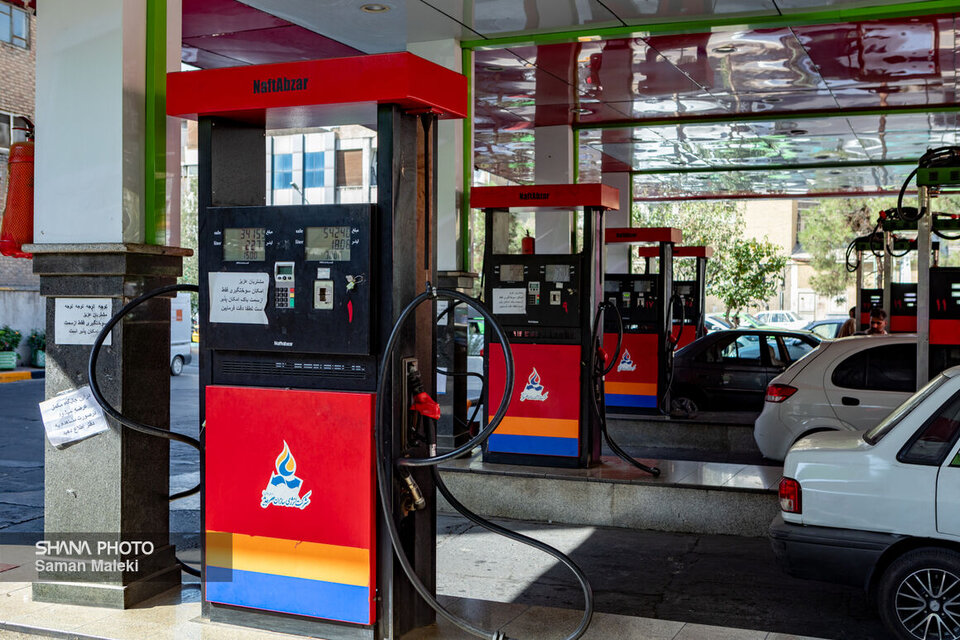
A review of recent consumption trends shows Tehran's daily average gasoline use has climbed to an unusually high 26 million to 27 million liters.
Two figures help put the surge in context. First, Tehran's average daily consumption in the Iranian calendar years 1404 (2025-2026) and 1405 (2026-2027) ranged between 20 million and 21 million liters, making the current volume a significant jump. Second, distribution industry records for the Tehran region show demand at this level only three times before, during two crises: the first day of the 12-Day War and the first two days of the Ramadan War.
The key difference this time is that past episodes produced long lines at stations but did not force any station closures. That contrast stems from two factors. During wartime conditions, authorities imposed limits on fueling amounts and frequency — including a 25-liter cap for purchases made with personal fuel cards — to slow the rate of withdrawal and maintain a rough balance between supply and demand. No such controls are in place under current, non-wartime conditions.
Compounding the problem is a decline in infrastructure and logistics capacity across the distribution network. Two strategic storage depots — in the northeast (Qouchak) and northwest (Shahran) — are completely offline, while the Rey oil depot is operating at only about 30% of its nominal capacity.
The reduced storage capacity has pushed the National Iranian Oil Products Distribution Company toward direct shipment, sending tankers straight from the Tehran refinery, the Imam Khomeini Refinery in Shazand, or nearby depots to city stations without passing through intermediate storage. The combination of sharply rising demand and a strained logistics process has not only produced long lines, due to stations' limited physical capacity, but has also led some stations to close because of fuel shortages.
Resolving the situation on a lasting basis will require faster repairs to storage infrastructure, a stronger fuel-transport fleet and greater resilience across the entire distribution chain.
Your Comment