
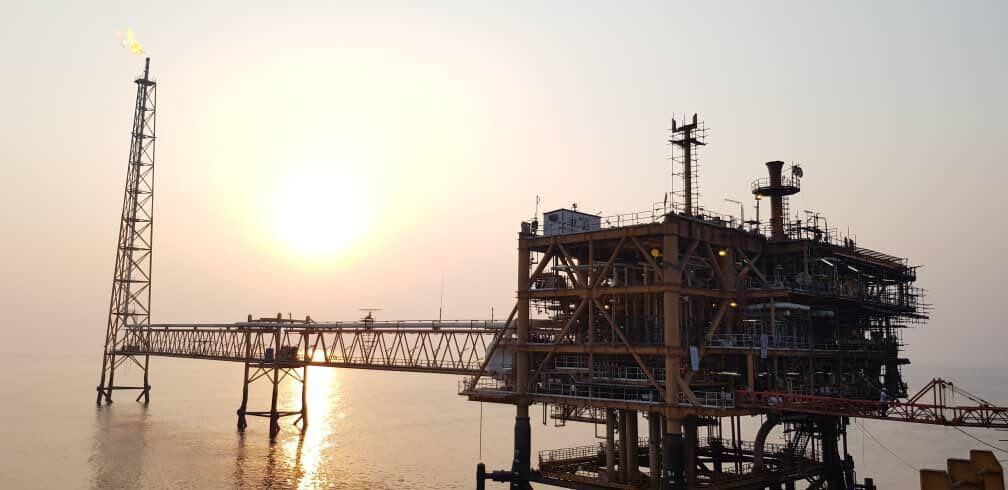
The 14th administration's track record in the gas sector has been marked by new production milestones, starting in winter1403 (2024-25) and reaching even higher levels the following winter. While the country's daily gas output reached 1.105 billion cubic meters in winter 2024-25, it surpassed that mark in winter 2025-26, climbing for the first time to 1.117 billion cubic meters per day.
This new record was 12 million cubic meters per day higher than the previous year's record, marking the highest daily gas production level of this period. In addition, average national gas production rose by roughly 41 million cubic meters per day from the start of the 14th administration's term through the end of the Iranian calendar year (March 2026).
These records are the result of operational and technical measures aimed at boosting production capacity and maximizing the use of existing capabilities across various parts of the oil and gas industry — pursued alongside the development and completion of production projects, along with maintenance and output-boosting programs at gas fields.
Reviewing these figures within the timeframe since the 14th administration took office offers a clear picture of the country's gas situation and underscores the need for greater production capacity — a point that Oil Minister Mohsen Paknejad had already emphasized in his program at the start of the administration's term.
That program noted that the country's average rich gas production from all active onshore and offshore fields stood at about 1,000 million cubic meters, which falls short of meeting the needs of the residential, commercial, and industrial sectors, power plants, petrochemical plants, and gas injection into oil fields — resulting in an average shortfall of roughly 250 million cubic meters per day during peak consumption months.
He had also warned that if the current trend continued, the gap between production capacity and required consumption would widen further, since rising consumption across sectors — particularly residential and industrial — would coincide with declining output from gas fields.
Guided by this careful, expert assessment, the Oil Ministry under the 14th administration prioritized addressing the production-consumption imbalance and emphasized managing it through both short-term and long-term measures. Accordingly, the National Iranian Oil Company was tasked with implementing a one-year short-term action plan, which included the continuous execution of gas field maintenance projects, such as workover drilling and other operational measures.
Among these measures was increased production from the shared South Pars field, where a significant portion of newly added capacity came from well development in the same field. In South Pars Phase 11, for example, seven new wells came online with a combined output of 15 million cubic meters per day. Phase 13 saw seven new wells added with a combined output of 10.5 million cubic meters, while Phase 14 brought two new wells online with a combined output of 3 million cubic meters per day.
Additionally, four new in-field wells on Platforms 1 and 2, A19, and B19 in South Pars came online with a combined output of 6 million cubic meters per day, and a new well on Platform C13 added another 1.5 million cubic meters per day to production capacity. Beyond the growth in gas output from the shared South Pars field, additional capacity was secured from other fields, including Dey, Aghar, Mozdouran, Dalan and Tang-e Bijar, Tous, and Khartang, among others.
Still, the path to increased gas production under the 14th administration was far from smooth. Alongside ongoing sanctions and the gas supply imbalance, the industry also faced difficult conditions stemming from attacks on gas facilities and South Pars refineries, making the repair of damaged infrastructure — alongside sustained production — a top priority. Despite these challenges, continuous gas production and delivery to the national grid was never interrupted, and the gas industry managed to maintain steady supply to the country while still expanding its production capacity.
Your Comment