
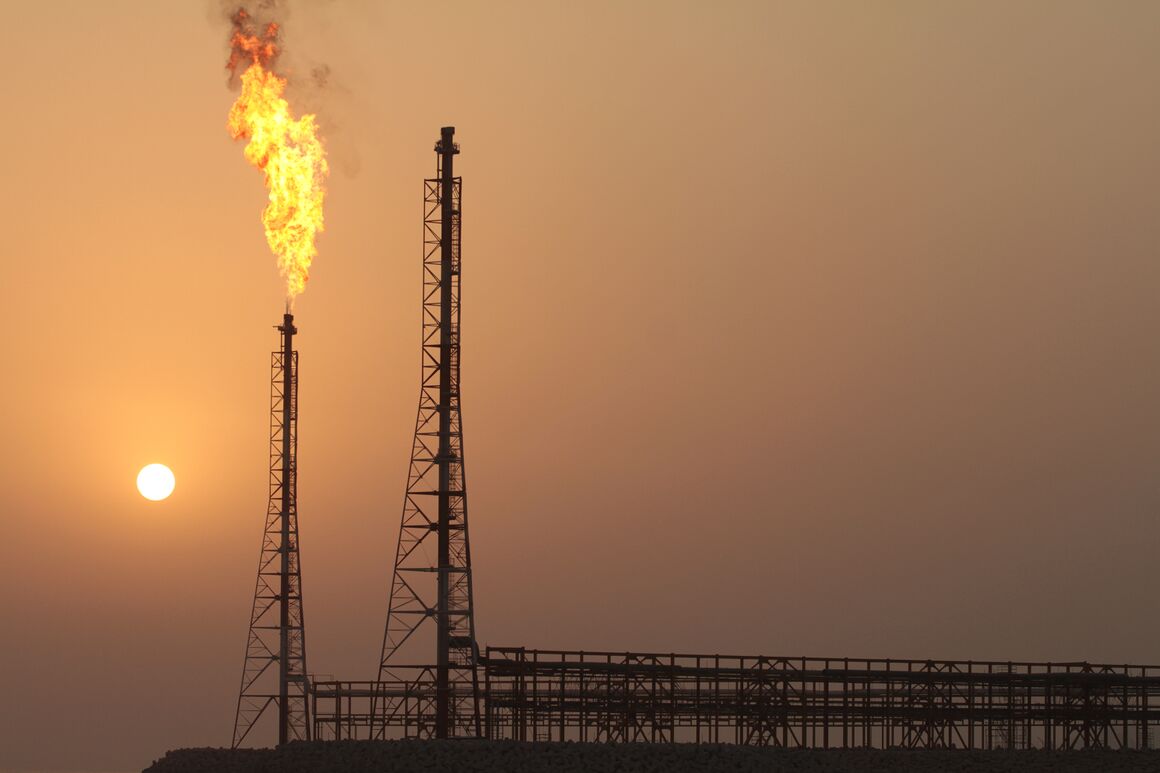
During this year’s Ten-Day Dawn celebrations (Feb. 1-11), another associated gas recovery project came online, underscoring the 14th administration’s firm resolve to prevent the waste of national resources and reduce environmental damage. The Dehloran Pressure Boosting Station was commissioned to collect associated gas from the Danan and Dehloran oil fields. Both fields have been producing for about 50 years, during which time their associated gas was routinely flared prior to the implementation of recovery plans.
With the launch of the Dehloran station, feedstock supply to the NGL 3100 plant has stabilized at about 1.8 million cubic meters per day. The recovered gas will also support downstream facilities, including the Dehloran petro-refinery complex. Against this backdrop, attention has turned to the Oil Ministry’s performance in flare and associated gas recovery under the 14th administration.
Associated and Flare Gas Recovery Surges 460%
Under the Seventh Five-Year Development Plan, Iran is required to recover a combined 44 million cubic meters per day of associated and flare gas by the end of 1407 (March 2029). Although the law sets cumulative targets for the end of the five-year period, the Supreme Program Steering Council has defined annual benchmarks to enable continuous monitoring of institutional performance.
By those measures, progress in the oil sector has been significant. According to a report by the Majlis Research Center, daily flare and associated gas recovery stood at about 3 million cubic meters per day in 1402 (March 2023–March 2024). Legislators projected a 36% increase to 4.11 million cubic meters per day in 1403. Instead, the oil industry achieved 9 million cubic meters per day through the execution of multiple recovery projects.
Malek Shariati Niasar, head of the Majlis energy committee’s task force overseeing implementation of the Seventh Plan, cited more than a 400% increase in flare gas recovery in the program’s first year. “Given two decades of underinvestment in this area, we need intensified efforts,” he said. “But the Oil Ministry’s pace of action is highly encouraging and could serve as a model for other sectors seeking to overcome similar backlogs.”
14th Administration Doubles Recovery Efforts
The Oil Ministry, responding to repeated calls by the president to curb the waste of national wealth, has accelerated flare and associated gas recovery initiatives. Oil Minister Mohsen Paknejad said that by mid-Bahman (early February), total recovery had reached about 16 million cubic meters per day, more than 9 million cubic meters of which was achieved under the 14th administration.
Despite these gains, roughly 55 million cubic meters per day — including 50 million cubic meters of associated gas and 5 million cubic meters of flare gas — is still being burned. The ministry says it has comprehensive plans to address the remaining volume.
Five major national projects are underway: NGL 3200, NGL 3100 Dehloran, construction of a gas and NGL facility on Kharg Island, a flare gas recovery project at Bidboland Persian Gulf Gas Refinery, and a flare gas collection initiative led by Maroon Petrochemical Co. Initial phases of some projects have been completed, and full commissioning is expected by 1407, subject to financing in certain cases.
Short-Term Contracts Engage Private Sector
Pending the completion of long-term national projects, the Oil Ministry has introduced short-term measures through temporary auction-based sales contracts aimed at capturing flare gas. The approach leverages private sector participation to minimize waste during the interim period.
Amir Moqiseh, investment and business development director at the National Iranian Oil Co., said 12 contracts signed in early Dey (late December) will enable recovery of approximately 8.5 million cubic meters per day. The projects have an implementation period of about 15 months and are expected to generate roughly $600 million annually. Six additional contracts are scheduled to be signed by year’s end, adding an estimated $65 million in annual revenue.
Paknejad said at the Dehloran station’s inauguration ceremony on Monday, Feb. 9, attended by the president, that within 15 to 16 months, the achievements tied to flare and associated gas recovery contracts are expected to extinguish about 32 flares.
With long-term national developments advancing alongside short-term private sector contracts, flare and associated gas recovery — once described as a distant aspiration — is increasingly becoming an attainable objective.
Your Comment