
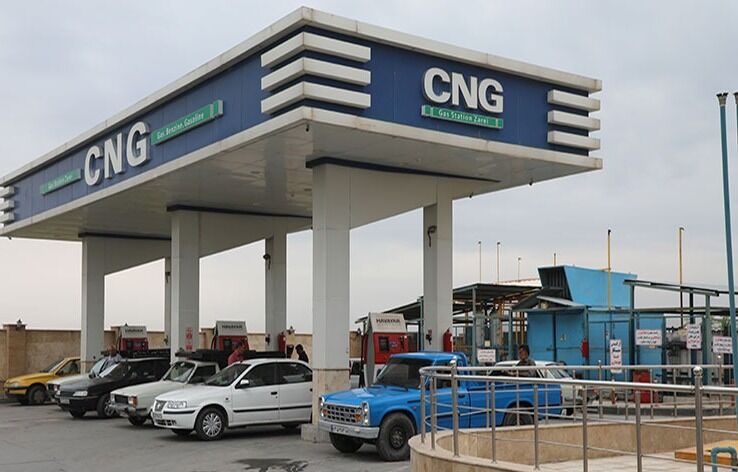
Despite the operation of more than 2,365 CNG fueling stations nationwide with a combined daily supply capacity of 40 million cubic meters, current consumption stands at only about 16 million cubic meters per day. Officials say greater use of CNG could save high-consumption households up to 500 million rials (about 50 million tomans) annually in fuel expenses.
Growing gasoline demand has become one of Iran’s main energy-sector challenges in recent years. While substantial investment has been made in CNG infrastructure over the past two decades, much of the network’s capacity remains underutilized. Officials believe policy reforms, expanded production of dual-fuel vehicles and accelerated vehicle-conversion programs could help bridge the gap and reduce pressure on gasoline supplies.
Saeed Rahman-Salari, head of NIOPDC’s CNG program, said one reason for limited consumer interest is the declining economic incentive to switch fuels. He emphasized the need for a meaningful price gap between gasoline and CNG to encourage broader adoption. He also cited lower production of factory-built dual-fuel vehicles as a factor behind weaker demand.
Iran’s CNG development program, launched in 2001 to diversify the transportation fuel mix, has created one of the country’s largest alternative-fuel distribution networks. However, with only 16 million cubic meters of daily consumption against 40 million cubic meters of available capacity, roughly 24 million cubic meters remain unused each day.
The country currently has about 4.3 million dual-fuel vehicles, either factory-produced or converted through certified workshops. Officials say there is approximately one CNG station for every 1,600 vehicles, indicating relatively strong infrastructure coverage. Expansion of fueling stations continues in underserved regions, including South Kerman and Sistan and Baluchestan provinces.
To increase CNG use, the government is pursuing both factory production and vehicle-conversion initiatives. In May 2025, NIOPDC signed an $18.5 million agreement with Zamyad to produce 30,000 dual-fuel Nissan pickup trucks. The project is expected to save 220 million liters of gasoline annually and reduce foreign exchange costs by about $90 million.
A separate $14.7 million agreement signed with Iran Khodro in August 2025 will support the production of 25,000 additional dual-fuel vehicles, with projected gasoline savings of more than 500,000 liters per day.
Meanwhile, a free vehicle-conversion program launched in summer 2025 allows taxis, pickup trucks and ride-hailing vehicles to convert from gasoline-only operation to dual-fuel systems at no cost. Private vehicle owners have also been included in phased registration rounds.
Officials say restoring CNG’s role in Iran’s fuel mix does not require major new infrastructure investment. Instead, success will depend largely on effective pricing policies, expanded dual-fuel vehicle production and stronger incentives for consumers to switch from gasoline to CNG.
Your Comment