
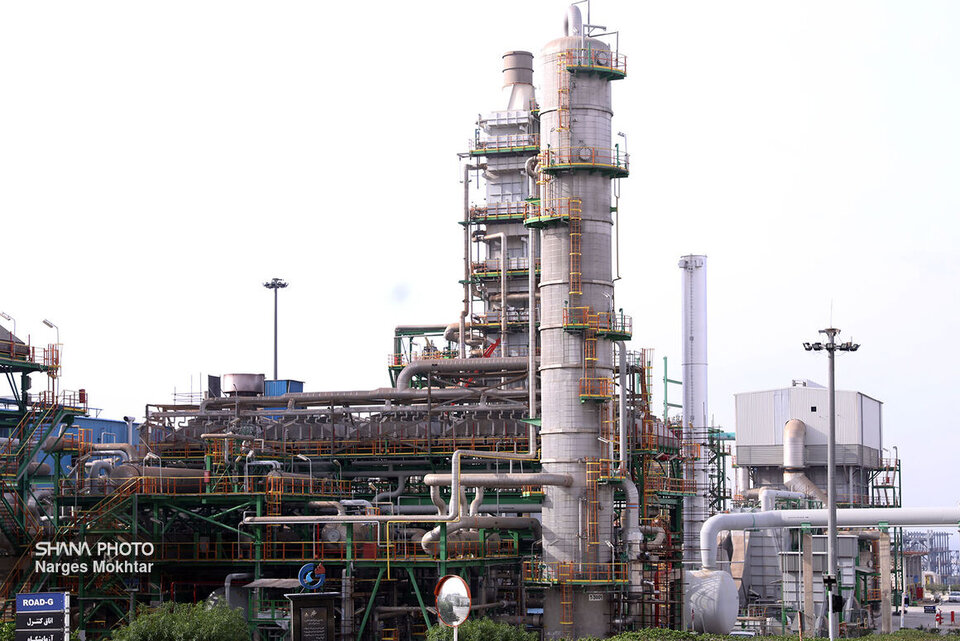
Hossein Rafiqdoust said Monday at a meeting titled “Dos and Don’ts of Completing the Methanol Value Chain and Revising the Feedstock Pricing Formula Amid Gas Imbalance,” held during the seventh Oil, Gas, Petrochemical and Refining Exhibition in Kish, that Fanavaran is focused on value-chain development and projects justified on technical, economic and market grounds.
He said extensive studies by the company’s strategic committee helped define Fanavaran’s development path based on international trends and domestic conditions. The Seventh Development Plan, he added, gives serious attention to completing the methanol chain, and the country’s petrochemical sector has the execution capacity to achieve these goals.
Rafiqdoust noted that a large share of Fanavaran’s output is exported. Accordingly, he said, in-depth studies with experienced consultants led to the identification of 10 top products in the methanol chain.
He added that Fanavaran supplies feedstock and products to several petrochemical complexes, including Razi, Karoun and Bandar Imam, while receiving part of its own feedstock from Razi Petrochemical Co. and the National Iranian Gas Co. This interaction has strengthened Fanavaran’s position in the industry’s supply chain.
Referring to developments in the global methanol market, Rafiqdoust said studies indicate that due to the underdevelopment of the domestic value chain, global methanol prices have been on a downward trend, leaving limited prospects for continued raw methanol exports. Expanding upstream and downstream chains has therefore become a strategic necessity, he said.
He reiterated that choosing the right projects must be based on three key factors: technology, market and marketing strategies.
Call to Revisit Petrochemical Development Policies
Ahmad Dehghan, CEO of Sepehr Energy Holding, also called for a reassessment of petrochemical development policies. He said transportation has become more difficult, costs have risen, and markets for base products are under pressure, warning that poor policymaking could turn development opportunities into threats.
Dehghan urged greater synergy across the industry, proposing that managers and companies work together through stronger associations to pursue policy demands with a unified voice.
He said Iran’s petrochemical sector has repeatedly shown it can turn constraints into opportunities, but success requires support from policymakers and reforms in macro-level approaches.
Sabalan Petrochemical Reports Output Increase
Reza Karimi, CEO of Sabalan Petrochemical Co., highlighted the trust in domestic capabilities, in improving profitability and growth. He said the use of an Iranin synthesis catalyst at Sabalan 1, despite initial risks, increased production to 107% of nominal capacity and helped transform the company into a profitable operation.
Karimi said Sabalan 1 was the first company in Iran to deploy the domestic synthesis catalyst. While early stages involved risks and the first year fell short of expectations due to physical issues, continued use delivered the desired results.
He said the experience demonstrates that relying on domestic technology can yield exceptional outcomes. Sabalan now recommends — and in some cases mandates — the catalyst’s use across other industrial companies, expressing hope for supportive economic incentives.
Karimi described the move as a major achievement for the industry, adding that entrusting high-tech equipment to local manufacturers requires risk tolerance and confidence. He called on manufacturers to respond by improving quality and adopting an export-oriented approach.
He said past experience shows that supporting domestic production, when combined with quality and technological advancement, can open export markets, noting that Sabalan’s Iranian synthesis catalyst is now used abroad.
Karimi stressed that localization should extend beyond equipment and catalysts to include technical knowledge, technology development and value-chain completion.
Khark Petrochemical Stresses Value-Chain Strategy
Komeil Pourziaei, CEO of Khark Petrochemical Co., emphasized the need for methane-based development. He said methane is central to the petrochemical industry’s development logic and should not be viewed merely as a cheap or temporary feedstock.
Pourziaei said Khark’s development programs are being pursued along three axis, or axes, beginning with methane-centered development. Methane, one of the simplest hydrocarbons, can be converted into a wide range of chemical products, requiring a shift from a feedstock-oriented to a chain-oriented perspective.
He said methane is not a short-term feedstock for Khark but a foundation for operational continuity, accumulated process experience and sustainable value-chain development.
Toward a “Methanol City”
Hamed Rezaei, head of the Innovation, Research and Development Center at Zagros Petrochemical Co., said Iran holds about 16% of the global methanol market. However, he warned that continuing on the current path without expanding the value chain exposes the country to economic and market risks.
Rezaei said the strategic goal should be to move from raw methanol exports toward the creation of a “methanol city” and the development of downstream industries. Such a shift would enhance economic resilience, reduce market risks and strengthen Iran’s position in the global chemicals chain.
He said the petrochemical innovation center was established with a problem-solving approach and has created collaborative spaces at Sharif University of Technology, the University of Tehran and other academic institutions, serving as think tanks that strengthen industry-academia ties.
Rezaei said a national methanol document is being prepared in coordination with relevant organizations and is expected to be unveiled under the Seventh Development Plan.
He said the future of Iran’s methanol industry depends on completing the value chain, developing advanced products, deepening industry-university cooperation and maintaining an active presence in global markets — a path that requires bold decisions and coherent policymaking.
Your Comment