
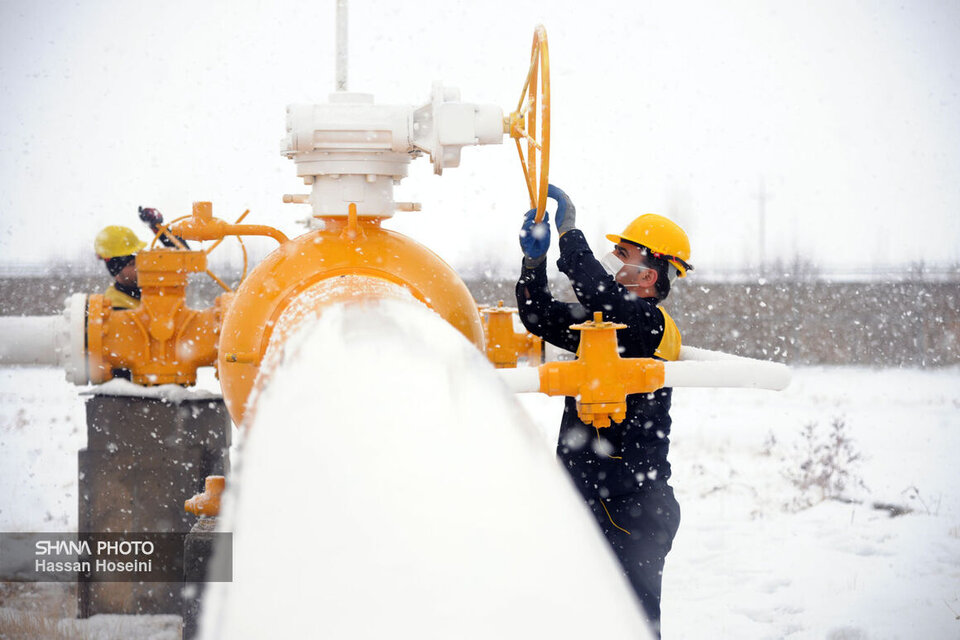
Household and commercial consumption reached an all-time high of 737 million cubic meters in a single day, yet gas deliveries to residential customers continued nationwide without interruption, officials said.
Despite tougher sanctions, the Oil Ministry under President Masoud Pezeshkian’s administration has pressed ahead with upstream development and production maintenance, focusing on expanding output capacity and reinforcing critical infrastructure to safeguard energy security during the coldest months of the year.
Development projects and operational improvements at the shared South Pars gas field have boosted daily production capacity by about 25 million cubic meters under the current government, helping narrow the gap between supply and demand.
Official figures show that South Pars output hit a record 727 million cubic meters per day. The field remains the backbone of Iran’s gas supply, providing a large share of fuel used by households, industries and power plants. Sustaining production at that level reflects the technical readiness of gas processing plants and round-the-clock work by industry personnel.
Still, this winter brought exceptional demand. Persistent cold across much of the country drove household and commercial consumption sharply higher. The National Iranian Gas Company said that on January 22, usage in those sectors alone reached 737 million cubic meters — about 10 million cubic meters more than daily output from South Pars — placing heavy strain on the network.
Supplying Homes a “Red Line”
More than 880 million cubic meters of gas injected into the national grid on peak winter days went largely to household and commercial users, which at times accounted for up to 85% of total demand, according to the report. Officials say ensuring residential supply is a top priority for the Oil Ministry.
Lower temperatures were compounded by the addition of about 700,000 new subscribers, significantly raising baseline winter demand.
Alongside the work of 20 gas refineries operating at maximum capacity, the scale of Iran’s transmission system proved critical. One of the world’s largest gas networks, it includes tens of thousands of kilometers of high-pressure and distribution pipelines, compressor stations, pipeline operation centers and a nationwide communications system.
The network carries gas from southern production hubs to cities and remote rural areas alike, making its winter stability a central measure of national energy security.
From Production to Transmission
Officials credited the uninterrupted service to close coordination among production, processing and transmission units, continuous real-time monitoring of the grid, and extensive maintenance carried out before the cold season.
The contrast with past winters is notable. In the Iranian year 1396, pressure drops on some trunk pipelines caused disruptions in parts of the country. This winter, despite record demand, persistent cold and the addition of hundreds of thousands of new customers, the network operated without pressure losses — a sign, authorities say, of stronger infrastructure and improved system management.
That performance reflects a series of measures, including upstream capacity expansion at South Pars, refinery upgrades, reinforced transmission lines, expanded compressor stations and the deployment of smart monitoring and control systems.
Officials added that consumer conservation and public cooperation were also essential in navigating the cold spell.
What unfolded this winter, they said, was the product of coordinated, around-the-clock efforts across the oil and gas value chain — from upstream fields and South Pars refineries to national pipelines and local distribution networks — underscoring the role of the industry’s workforce in maintaining grid stability and protecting Iran’s energy security during extreme conditions.
Your Comment