
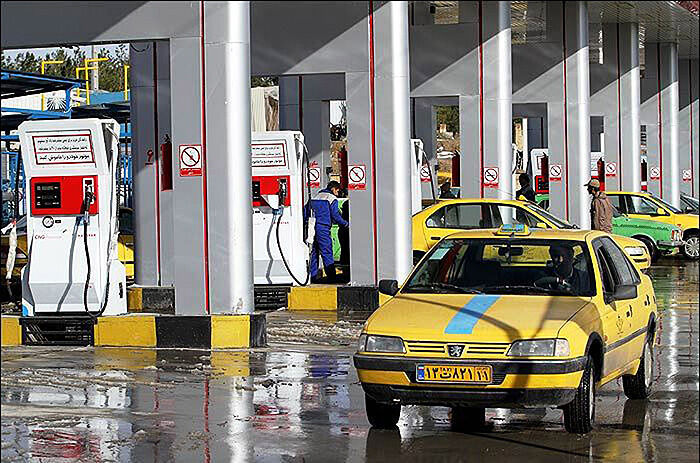
According to the National Iranian Oil Refining and Distribution Company, diversifying the national fuel mix was placed on the agenda at the start of the 14th administration. A range of steps over the past year has aimed to advance that goal. Rising gasoline consumption and the underuse of fuels such as compressed natural gas and liquefied petroleum gas have underscored the need to diversify Iran’s fuel portfolio.
Fuel mix diversification
Projects tied to fuel diversification were unveiled in late February last year in a ceremony attended by Mohammad-Sadeq Azimifar, CEO of the National Iranian Oil Refining and Distribution Co., and Keramat Veis-Karami, CEO of the National Iranian Oil Products Distribution Co.
The event marked the commissioning of 12 CNG stations in East Azarbaijan, Kerman, Isfahan, Lorestan, Razavi Khorasan and Sistan and Baluchestan provinces. Memorandums of understanding were also signed on the use of bioethanol in fuel supply with the Industrial Development and Renovation Organization of Iran, on the production of dual-fuel vehicles with Iran Khodro and Zamyad, and on resuming operations of the system for converting gasoline-powered vehicles to dual fuel.
Expansion of dual-fuel vehicles
Following the rollout of fuel diversification projects, the development of dual-fuel vehicles has proceeded through factory production and workshop-based conversions. With a significant portion of CNG capacity still unused, the government has focused on expanding infrastructure to enable fuller use of the fuel.
About 24 years after the launch of Iran’s CNG industry, the country now has 2,360 CNG stations with a daily supply capacity of 40 million cubic meters. Actual consumption, however, has fallen to about 16 million cubic meters per day.
To boost utilization, the government has signed contracts with automakers to expand dual-fuel vehicle production. In late May, the National Iranian Oil Products Distribution Co. signed an $18.5 million contract with Zamyad to support production of 30,000 dual-fuel Nissan pickup trucks.
Under the one-year agreement, the vehicles will be added to the national transportation fleet. The project is financed through gasoline savings under Article 12 of the Law on Removing Barriers to Production. Officials estimate the vehicles will save about 220 million liters of gasoline annually, equivalent to roughly $90 million in foreign exchange savings.
In late August, another contract was signed with Iran Khodro to produce 25,000 dual-fuel vehicles, aimed at saving more than 500,000 liters of gasoline per day. Valued at $14.7 million, the contract is funded through natural gas savings under government support measures approved by the Supreme Economic Council. Once operational, the vehicles are expected to reduce daily gasoline consumption by more than 500,000 liters.
Launch of free vehicle conversion program
In addition to factory production, a free conversion program for privately owned vehicles began in mid-summer 2025. In Aug. 2025, the CEO of the National Iranian Oil Products Distribution Co. announced the start of registration for free conversion of gasoline-powered vehicles from model year 2018 onward.
He said more than 110 billion cubic meters of CNG have been supplied nationwide over the past two decades, equivalent to saving 110 billion liters of gasoline.
Public vehicles, including taxis, pickup trucks and vehicles used by online ride-hailing services, can register through gcr.niopdc.ir. After registration, vehicles are referred to one of 340 active conversion workshops nationwide, where conversions are performed free of charge. Owners of private vehicles from model year 2018 onward are also eligible to register.
Commissioning new CNG stations
Eight new CNG stations were commissioned in November to expand clean fuel use and increase CNG’s share in the national fuel mix. With a combined capacity of 11,280 cubic meters per hour, the stations were built with an investment of 6.1 trillion rials by the government in partnership with the private sector.
The single- and dual-purpose stations are located in Varamin, Talesh, Ziveh, and the cities of Zahedan, Isfahan, Zabol and Tabriz. In some areas, the stations mark the first operational CNG facilities. In Sistan and Baluchestan province, the number of CNG stations has increased to nine from three under the 14th administration, with four more planned by year’s end.
CNG development and reduced reliance on gasoline
Taken together, the government’s actions on fuel diversification reflect an operational approach aimed at reducing reliance on gasoline and maximizing underused resources such as CNG. Infrastructure development, expansion of fueling stations, contracts with automakers and free vehicle conversion programs are expected, if sustained, to help manage gasoline consumption, cut foreign exchange costs and strengthen energy security.
Continued progress, particularly with private-sector participation and cooperation from the automotive industry, could solidify the role of alternative fuels in Iran’s energy mix and help address fuel imbalances in the medium term.
Your Comment