
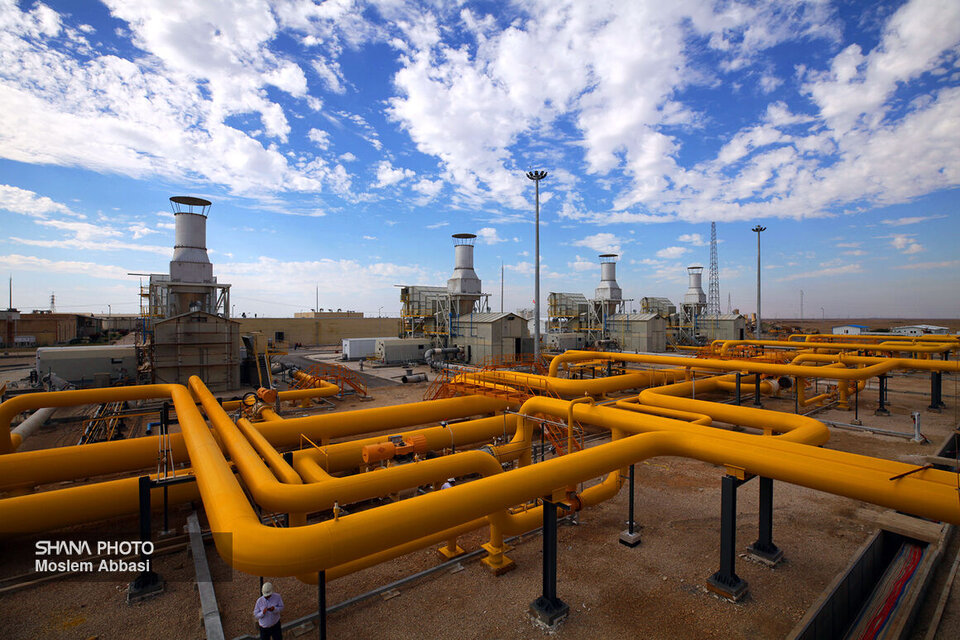
The ministry said steps ranging from increased raw gas production and refinery development to strengthening transmission lines and completing major overhauls before the cold season helped prevent service disruptions for consumers.
This winter began with widespread and sustained cold across the country, pushing residential and commercial gas consumption to record levels. The addition of thousands of new subscribers further increased demand, placing the gas network under significant pressure. Despite these challenges, the Oil Ministry said careful management of gas production and distribution, along with continuous network monitoring, maintained energy supply nationwide.
Gas consumption in the residential, commercial and industrial sectors reached a record 737 million cubic meters per day, the ministry said, without any household supply cuts.
Winter readiness and gas infrastructure maintenance
Early completion of major overhauls at gas refineries, equipment and transmission lines was cited as a key factor in maintaining network stability. The preventive work ensured refineries and pipelines operated at full capacity and were able to respond to sudden spikes in residential demand. Officials said early infrastructure preparation remains central to energy security during winter.
The successful completion of refinery overhauls while maintaining sufficient gas supply for power plants during peak summer demand reflected effective planning, technical capacity and sustained production stability, the ministry said. These efforts also contributed to improved efficiency, safety and long-term development of Iran’s gas industry.
Iran Gas Transmission Company carried out extensive maintenance and optimization work ahead of winter 1404 (2025-26), including more than 45 pipeline repair operations, 43 turbine overhauls and leak detection along more than 39,000 kilometers of pipelines. The company also replaced 24,700 square meters of pipeline coating, brought 724 kilometers of new pipelines into operation, increased transfer capacity at the Ramsar facilities and repaired 1,100 critical points on main and export gas lines. Operational staff worked extended shifts to keep the network stable.
Officials said comparisons with past winters, including 2017, highlight significant improvements in infrastructure and network management. While some pipelines experienced pressure drops that year, the network this winter was managed without pressure loss despite sustained cold, higher consumption and new subscribers.
Production capacity increases
The Oil Ministry said raw gas output from the shared South Pars gas field rose by about 25 million cubic meters per day this year, with production reaching 727 million cubic meters per day. Expanded capacity and operational optimization at South Pars allowed daily deliveries of more than 870 million cubic meters of processed gas to the national grid during peak winter demand, ensuring network stability.
Coordination across upstream production, refining and transmission operations—supported by 20 active gas refineries, an extensive high-pressure pipeline network, compressor stations and operational centers—was described as the backbone of energy supply stability this winter.
Underground storage facilities at Sarajeh and Shourijeh also played a key role, particularly during cold months. Sarajeh, Iran’s first underground natural gas storage site, and Shourijeh, which supports supply stability in the northeast, saw a 20% increase in gas injection this year, according to official figures, helping prevent fluctuations in the consumption network.
Focus on power plants
Reports also show that stable network management allowed gas deliveries to power plants to reach record levels earlier in the year. On Sept. 9, daily gas consumption by power plants hit 329 million cubic meters, the highest level recorded in 1404.
While household supply remains a priority during winter, officials said gas deliveries to power plants continued without interruption. Saeid Tavakoli, managing director of the National Iranian Gas Co., said Jan. 19 that more than 170 million cubic meters of gas had been delivered daily to power plants for three consecutive days, adding that total deliveries since the start of the year had risen by more than 3 billion cubic meters.
Workforce key to energy security
The Oil Ministry said the achievements reflect a combination of targeted measures, including increased upstream production, new output records at South Pars, expanded refining capacity, strengthened transmission lines, smart network control systems and early maintenance. Public cooperation and responsible consumption were also cited as contributing factors.
Coordinated efforts by oil and gas sector employees across the entire value chain—from upstream fields and South Pars refineries to transmission and downstream distribution—demonstrate that human capital remains the country’s primary asset in maintaining network stability and ensuring energy security during severe winter conditions.
Your Comment