
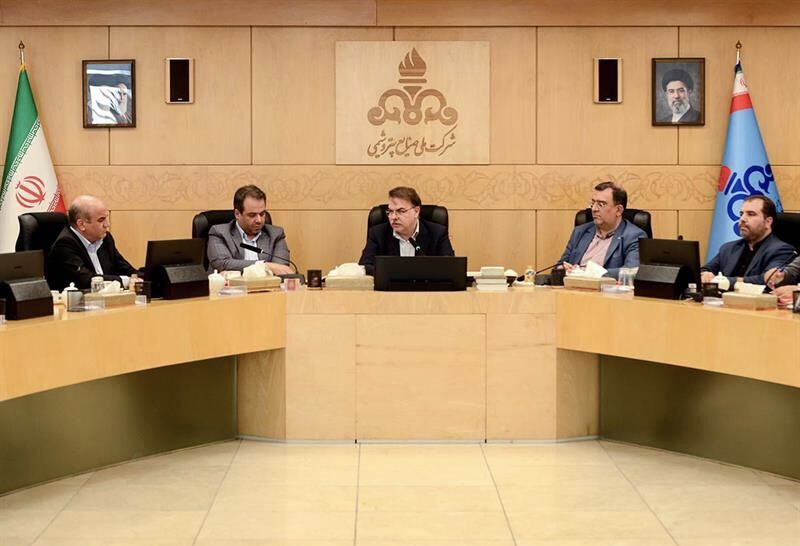
Omid Shakeri, the company's caretaker, said smart governance is impossible without accurate, up-to-date and reliable data. He said the program's goal is to create data authority within the petrochemical sector and turn information into the foundation for management and policy decisions.
Speaking at the signing ceremony, Shakeri thanked NPC managers and staff for leading the initiative, calling it a transformative step for the industry's governance.
He said the industry's governance model has shifted as the private sector has expanded. In the past, he said, most of the state company's interactions with its subsidiaries followed different processes. Today, he said, governing the industry requires exchanging, managing and analyzing precise, standardized data more than ever before.
Shakeri said the more accurately and reliably data is produced and managed, the more effective management decisions will be.
Drawing on years of information technology projects, he said Iran has built numerous databases and systems, but warned that creating databases alone is not the goal. Data must become a decision-making tool that helps solve problems and improve organizational performance, he said.
A Problem-Focused Approach
Shakeri described his management approach as "problem-focused," saying every program must ultimately solve a problem or lose its value. He said the data governance plan will succeed only when its effects become visible in management decisions and improved industry performance.
He called on the company to make data governance a core priority pursued with consistency, adding that the Oil Ministry and the Administrative and Employment Affairs Organization would help remove any obstacles.
Shakeri said the agreement's ultimate goal is to enable smart, data-driven decisions, noting that government agencies increasingly need precise, coherent and citable information. The petrochemical industry, he said, must organize its data to meet that need.
He added that one of the program's key achievements will be establishing data authority in the petrochemical sector — a system that can provide managers, policymakers and other stakeholders with reliable, integrated information to support more precise decisions across the industry and government.
Shakeri said he hoped the agreement, backed by close cooperation between the Oil Ministry, National Petrochemical Co. and the Administrative and Employment Affairs Organization, would mark a meaningful step toward smart management in the petrochemical industry.
Oil Ministry Could Become National Model
Mohammadreza Torki-Boyouki, who heads national systems and data-based governance strategy at the Administrative and Employment Affairs Organization, said data governance cannot be achieved simply by building systems and management dashboards.
He said the Oil Ministry, given the scale of its operations and the volume of data it produces, has the capacity to become a national model for data governance. He cited the ministry's broad activities, ties to private companies and heavy data output as reasons it could set the standard.
Torki-Boyouki called the agreement the start of a transformative process, saying the goal extends beyond building technology infrastructure or producing data. Data, he said, must be used in decision-making, planning, service redesign and solving organizational problems.
He noted that significant investments have been made in information technology in recent years, and said Iran no longer faces shortages in infrastructure, storage or data production. The real challenge, he said, is using that capacity effectively in management and decision-making.
Torki-Boyouki called culture-building the first prerequisite for data governance, saying training and instilling a data-driven mindset among managers matters more than simply expanding technology systems. He said human resources management, planning, resource allocation and even performance evaluation should all be data-based.
Data Must Drive Decisions, Fix Processes
Torki-Boyouki criticized what he called the ceremonial use of management dashboards, saying many dashboards built across government agencies serve only a display function rather than supporting real decision-making. Such systems add no value, he said, unless the data they generate leads to decisions, process fixes and solved problems.
He praised the Oil Ministry's proactive stance, saying that unlike some agencies that must first be convinced of the need for data governance, the ministry has shown strong enthusiasm for the shift — a factor he said could speed up digital transformation efforts.
He stressed the need for shared standards between the Oil Ministry and private companies in the refining and petrochemical sectors, saying effective cooperation requires a common language, data-exchange standards and clear information-sharing mechanisms.
Torki-Boyouki said digital transformation must ultimately improve service quality and stakeholder satisfaction. He noted that many major transformations begin with simple, practical projects rather than large, complex ones.
He described the plans under the agreement as one-year operational initiatives, saying success will be measured by real progress and results rather than the volume of documents produced.
He said the agreement's main goal is to spread a data-driven mindset across the organization, adding that officials expect planning, human resources, support functions and other management processes to eventually operate on a data basis as well.
Torki-Boyouki also stressed the need for close cooperation between specialized units and information technology teams, saying IT should not function as an isolated department but should be embedded in core business processes to speed up digital transformation projects.
About the Agreement
The tripartite memorandum, signed Sunday, aims to develop data-driven management, improve decision-making quality and establish smart governance across Iran's petrochemical industry. It was signed by the Oil Ministry, NPC and the Administrative and Employment Affairs Organization.
The agreement sets a cooperative framework for establishing data-based governance, developing smart management, improving decision-making, integrating data processes and using data more effectively in petrochemical industry policy and planning.
Under the agreement, NPC is required to plan, implement and establish the data governance system within its organization over the next year, following the model and operational requirements set out in the pact.
Your Comment