
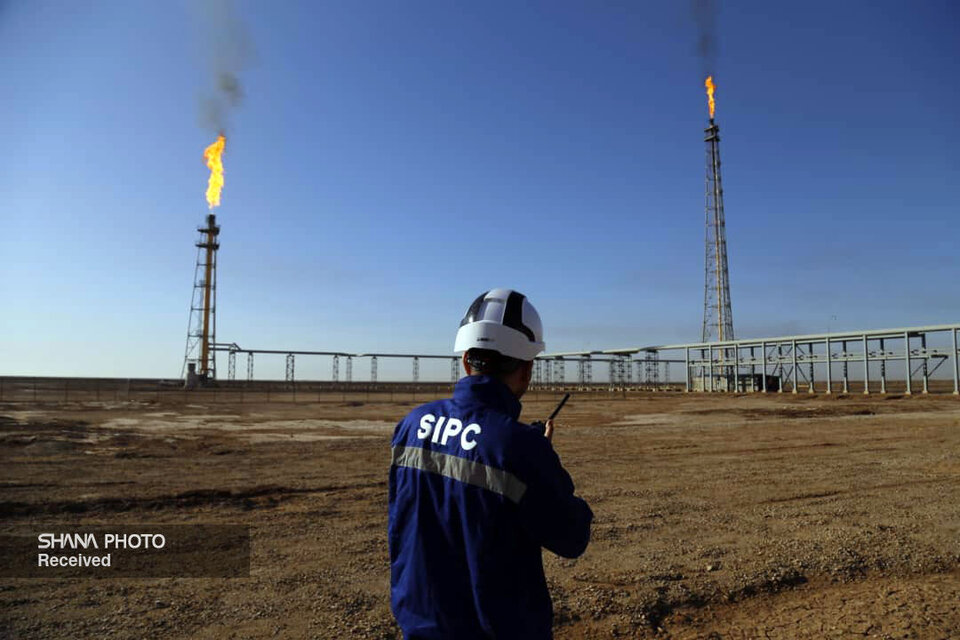
Gas flaring has long been one of the oil industry’s most persistent problems, causing heavy financial losses and serious environmental damage. But backed by sustained oversight from the presidency, the Oil Ministry has accelerated efforts to address the issue through targeted investment, structured planning and lessons drawn from past experience.
Large-scale flare-gas recovery and utilization projects have been elevated to the top of the ministry’s agenda. Multiple projects have already come online, with tangible results reflected in official assessments of the government’s performance under the country’s Seventh Five-Year Development Plan.
460% increase in flare reduction
The improvement is detailed in a report by the Iranian Parliament Research Center reviewing agencies’ performance in implementing the Seventh Development Plan. According to the report, flare-gas collection rose by 460% in the first year of the plan (2024).
Under the plan, annual flare-gas recovery was expected to rise from 1.1 billion cubic meters in 2023 to 1.5 billion cubic meters in 2024, an increase of 36%. Instead, the oil industry boosted the figure to 3.3 billion cubic meters, surpassing the target by a wide margin.
The longer-term goal remains more ambitious. Under the five-year plan, Iran aims to collect 16 billion cubic meters of flare gas annually — about 43 million cubic meters per day — by 2028. Officials say additional measures are underway to reach that target.
Dual-track strategy
The Oil Ministry is pursuing a two-pronged approach to curb flaring and turn wasted gas into productive output, combining major national projects with short-term initiatives.
According to the National Iranian Oil Co., the strategy relies on long-term projects — including construction of natural gas liquids (NGL) units and associated gas gathering facilities, particularly in East Karun — alongside short-term measures such as auctioning and selling flare gas until permanent facilities are completed.
Status of major projects
Five large national flare-gas collection projects are currently underway.
The Dehloran NGL 3100 project, with investment exceeding $1.4 billion, is designed to collect nearly 7 million cubic meters of associated gas per day in Ilam province. It is more than 97% complete.
The NGL 3200 project, also known as the Hoveyzeh Persian Gulf Gas Refinery, is expected to collect more than 14 million cubic meters of flare gas per day in West Karun and has reached about 84% completion.
A flare-gas recovery project run by Maroun Petrochemical Co., targeting more than 5 million cubic meters per day from the Ahvaz and Maroun fields, has progressed by 79%. Its subprojects are scheduled to be completed and commissioned gradually by early 2027.
At the Bidboland Persian Gulf Gas Refinery, a major flare-gas collection project is designed to recover nearly 17 million cubic meters per day from the Maroun, Aghajari, Rag Sefid, Gachsaran and Bibi Hakimeh fields. The project is about 75% complete.
The fifth project focuses on offshore operations, involving construction of a gas and LPG plant on Kharg Island. It is expected to collect about 8 million cubic meters per day from the Forouzan field and other offshore fields. Subject to financing, it is slated for completion in 2028.
In addition, several smaller projects have been defined at gas refineries in Assaluyeh, at the Pars 1 and Pars 2 sites, with a combined capacity of about 7 million cubic meters of flare gas per day.
Short-term measures to prevent waste
Alongside long-term investments, the Oil Ministry has launched short-term projects through temporary auction and sales contracts, aiming to curb flaring by tapping private-sector capacity until national projects are fully operational.
Officials estimate that about 48.5 million cubic meters of flare gas per day could ultimately be collected through these short-term measures. So far, seven such projects — including Parsy Cluster (Aghajari), Maroun 3, Mansouri, Maroun 5 (sour and sweet Asmari), Maroun 6 and Cheshmeh Khosh — are collecting about 60 million cubic feet per day, or roughly 1.7 million cubic meters.
Contracts covering an additional 3.9 million cubic meters per day have been signed and are under implementation. Another 7.7 million cubic meters are in the auction and transfer process, while 1.5 million cubic meters are at the call-for-bids stage. The remaining capacity is also being offered under zero-base calls and is expected to be assigned soon.
Oil Minister Mohsen Paknejad has said that with completion of all flare-gas recovery projects by the end of 2028, Iran expects to fully eliminate gas flaring nationwide. Officials describe the goal as a symbol of national self-reliance, maximum use of domestic capabilities, protection of national resources and a major step toward environmental preservation and economic resilience.
Your Comment